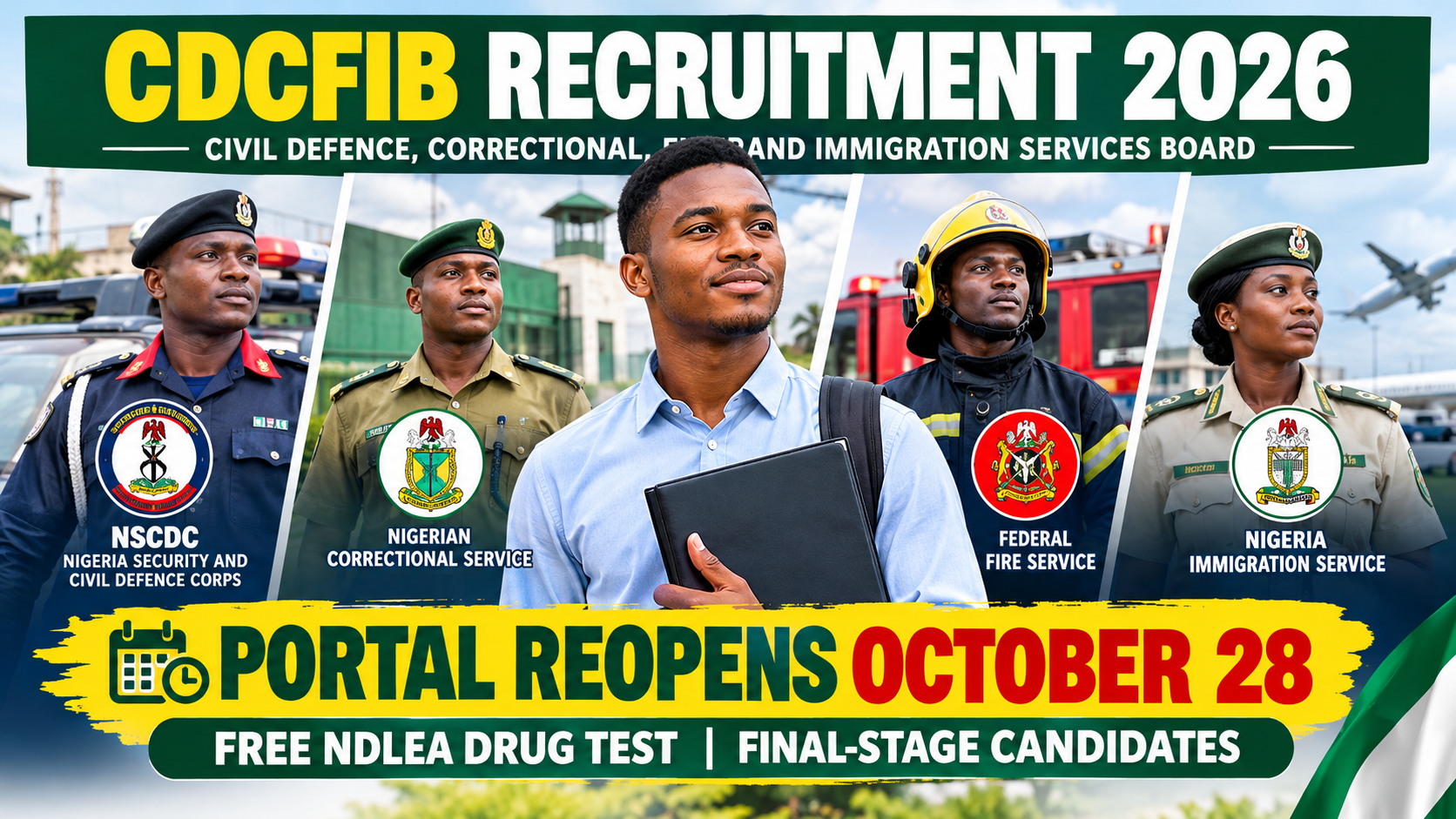
CDCFIB Recruitment 2026: Portal Reopens October 28 for Final-Stage Candidates
The Civil Defence, Correctional, Fire and Immigration Services Board (CDCFIB) has announced that its recruitment portal will reopen from October 28 to November 13, 2026, for candidates who have reached the oral-interview stage of the ongoing paramilitary recruitment exercise.
The reopening will allow eligible candidates to check their recruitment status and follow instructions for a compulsory drug test conducted by the National Drug Law Enforcement Agency (NDLEA).
According to reports of the board’s latest announcement, the drug test is free of charge, with the Federal Government covering the cost. Candidates who are instructed to undergo the test must follow the official procedure and satisfy the remaining recruitment requirements before collecting their appointment letters.
Important: This is not a fresh recruitment exercise. The portal reopening is intended for candidates already participating in the ongoing recruitment process who have progressed to the oral-interview stage.
Candidates should use the official CDCFIB recruitment portal and rely on instructions displayed on their individual profiles.
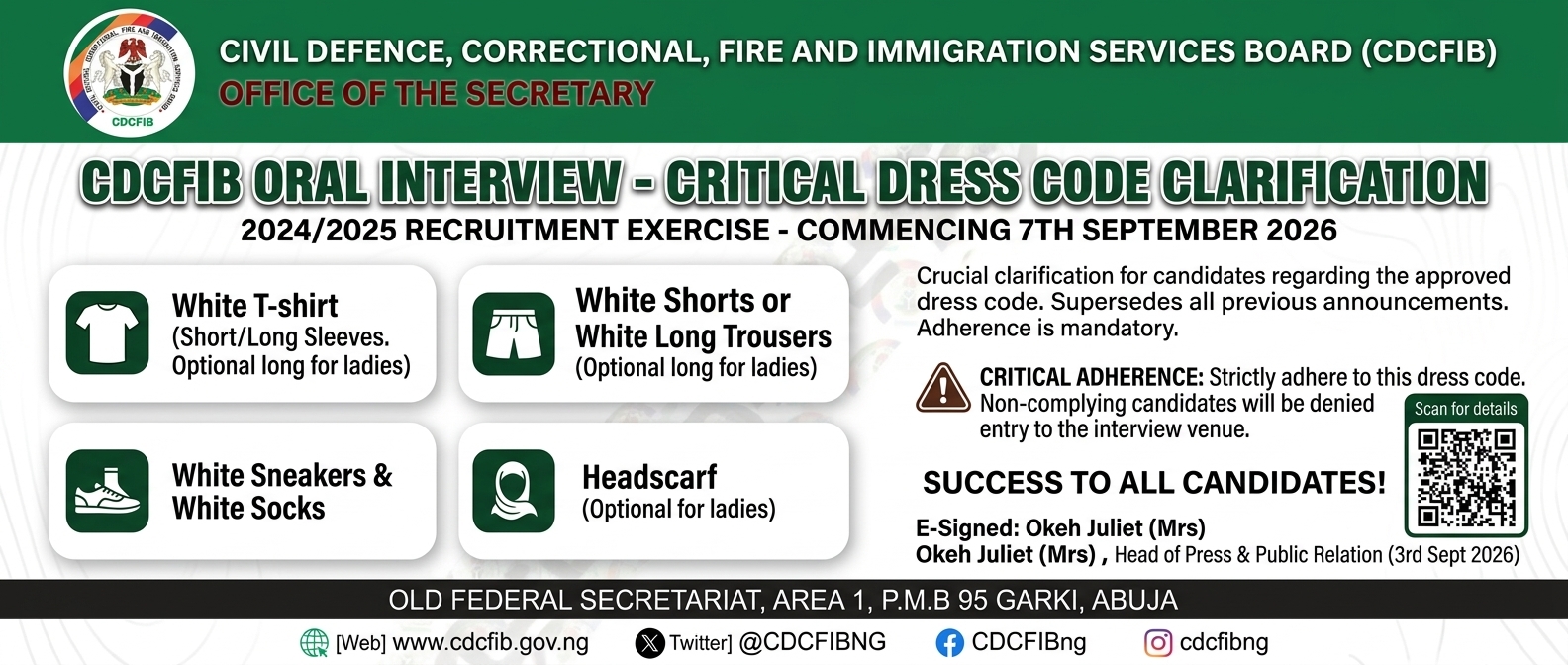
Read more on CDCFIB Oral Interview 2026: Dress Code, Screening Dates and Requirements
What Candidates Should Know About the CDCFIB Portal Reopening
The recruitment portal is scheduled to reopen on October 28 and close on November 13, 2026.
During this period, eligible candidates should log in using their existing application details, check their recruitment status and follow any instructions provided by the board.
Candidates who are directed to take the drug test are expected to obtain the required screening code through the portal and visit the designated NDLEA office in their respective states.
The test is a compulsory part of the final recruitment process for candidates covered by the directive. Reaching the oral-interview stage does not automatically guarantee appointment, as candidates must still satisfy the outstanding requirements.
Organisations Covered by the CDCFIB Recruitment
The Civil Defence, Correctional, Fire and Immigration Services Board oversees recruitment into four paramilitary organisations in Nigeria.
1. Nigeria Security and Civil Defence Corps (NSCDC)
The Nigeria Security and Civil Defence Corps is responsible for protecting lives, property and critical national assets. Its duties include supporting security operations, protecting public infrastructure and assisting during emergencies.
2. Nigerian Correctional Service (NCoS)
The Nigerian Correctional Service manages custodial facilities and the lawful custody of inmates. Its responsibilities also include rehabilitation, reformation, vocational training and reintegration programmes.
3. Federal Fire Service (FFS)
The Federal Fire Service is responsible for fire prevention, firefighting and rescue operations. Its activities include responding to fire outbreaks, conducting fire-safety education and supporting rescue operations during emergencies.
4. Nigeria Immigration Service (NIS)
The Nigeria Immigration Service manages immigration matters, including border control, passport administration and the regulation of foreigners residing in Nigeria. It also helps enforce immigration laws and supports national security.
These are the four services covered by the ongoing CDCFIB recruitment exercise.
How the CDCFIB Recruitment Process Has Progressed
The recruitment exercise has involved several stages designed to assess applicants’ eligibility, qualifications, physical fitness and suitability for paramilitary service.
Stage One: Online Application
Candidates initially submitted applications through the recruitment portal, selecting one of the four services and providing their personal information, educational qualifications and other required details.
Applicants were expected to provide accurate information and upload the necessary documents. Inaccurate information, duplicate applications or failure to meet the eligibility conditions could lead to disqualification.
Stage Two: Application Review and Shortlisting
After the application period closed, submissions were reviewed to determine whether candidates had completed the required fields, supplied acceptable documents and met the stated eligibility requirements.
Applications that did not satisfy the requirements could be classified as incomplete or disqualified.
Stage Three: Computer-Based Test
Eligible candidates were invited to take a computer-based test (CBT). The examination assessed areas such as general knowledge, reasoning and comprehension.
Candidates’ performance and compliance with examination rules helped determine who could proceed to subsequent stages.
Stage Four: Physical Screening
Candidates who progressed were invited for physical screening to assess whether they met the relevant physical requirements for their chosen service.
Depending on the applicable criteria, screening may include checks relating to height, physical condition and other stipulated requirements.
Stage Five: Document Verification
At this stage, candidates were expected to provide original documents and other acceptable evidence supporting the information submitted during registration.
These checks help verify academic qualifications, identification details and other relevant records. Discrepancies or false documents may result in disqualification.
Stage Six: Medical Examination
Medical screening helps determine whether candidates are fit to perform the duties associated with their intended appointments.
Candidates must follow the board’s requirements and any instructions provided during the assessment.
Stage Seven: Oral Interview
The oral interview is the latest completed stage mentioned in the recruitment update. It may assess candidates’ communication skills, confidence, background, understanding of the service and overall suitability.
The latest portal reopening concerns candidates who have reached this stage and are awaiting further instructions.
Mandatory NDLEA Drug Test: What Candidates Need to Do
Candidates who are instructed to undergo the drug test should follow the procedure communicated through the official recruitment portal.
The reported steps are:
- Visit the official portal: Go to recruitment.cdcfib.org during the announced period, from October 28 to November 13, 2026.
- Check your recruitment status: Log in with the application details you used during registration.
- Follow the portal instructions: If directed to take the drug test, obtain the required screening code and note the instructions provided.
- Visit the designated NDLEA office: Attend the test in your state as instructed by the board.
- Keep the required documentation: Retain the test result or clearance certificate and follow the official instructions concerning any further verification or appointment-letter collection.
Candidates should confirm the precise location, required documents and next steps through their portal profiles or authorised communication channels. They should not rely solely on forwarded messages or unofficial social media posts.
Is the CDCFIB Drug Test Free?
Yes. According to reports of the board’s announcement, the mandatory NDLEA drug test will be provided free of charge, with the Federal Government bearing the cost.
Candidates should not pay individuals who claim they can provide screening codes, arrange special treatment, guarantee a successful outcome or secure an appointment letter.
Anyone asked to pay for the compulsory test should report the demand to the appropriate security authorities.
When Will Successful Candidates Collect Their Appointment Letters?
Candidates who complete the required screening and satisfy the remaining recruitment conditions may proceed to the appointment-letter collection stage, following the board’s instructions.
Reports of the latest announcement state that candidates who meet the drug-test requirement will be directed to Abuja for the collection of their appointment letters.
However, candidates should wait for official instructions regarding their individual status, documentation and collection arrangements. Passing one stage does not, by itself, guarantee final appointment.
Important Warning for CDCFIB Applicants
The reopening of the portal should not be interpreted as an invitation for new applicants to submit fresh applications.
The announced window is intended for candidates who have already participated in the recruitment exercise and reached the oral-interview stage. Anyone who did not participate in the ongoing exercise should wait for an official announcement of a new recruitment opportunity.
Applicants should also protect their login credentials, avoid unofficial recruitment agents and never share sensitive information with people claiming to have special access to the board.
For updates, use the official CDCFIB recruitment portal and the board’s official website.
Final Advice
The CDCFIB recruitment portal is scheduled to reopen from October 28 to November 13, 2026, for eligible candidates who have reached the oral-interview stage. They should use the period to check their status, obtain any required drug-screening instructions and complete the remaining steps.
The NDLEA drug test is reported to be compulsory and free of charge. Candidates should follow the official procedure, keep their documentation safe and avoid anyone demanding money in connection with recruitment.
Before taking action, confirm the latest instructions on the official CDCFIB portal. Recruitment procedures and dates may change, and the board’s authorised announcements should take precedence over unofficial reports.