Nigerian Navy Recruitment 2026: Batch 39 Requirements and How to Apply
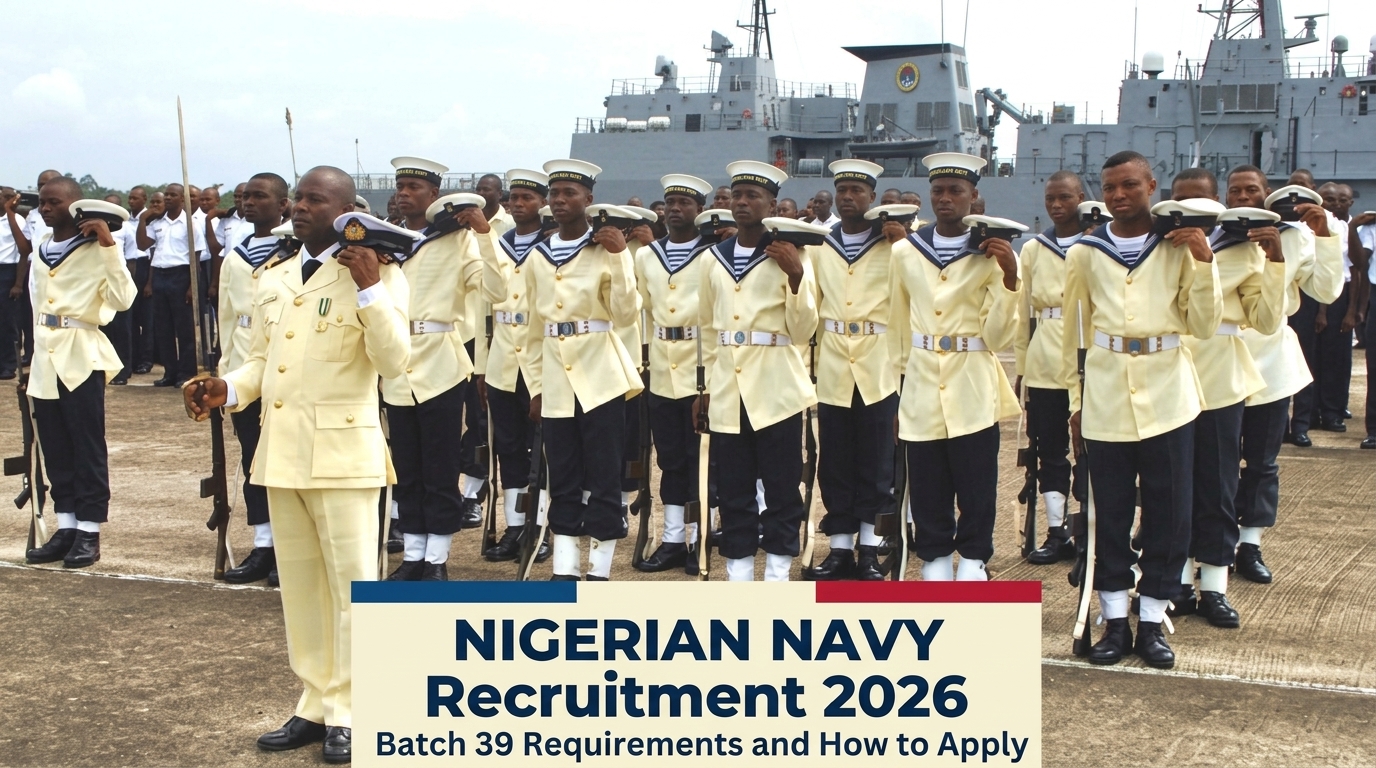
The Nigerian Navy Recruitment 2026 exercise for entry into the Nigerian Navy Basic Training School (NNBTS), Batch 39, has been announced for eligible Nigerians.
According to the supplied recruitment information, applications will open from 2 October to 31 October 2026. Registration and all related recruitment processes are free of charge, and applicants are advised not to pay anyone to participate in the exercise.
Interested candidates are expected to apply only through the official Nigerian Navy recruitment portal at www.joinnigeriannavy.navy.mil.ng. Multiple applications can result in automatic disqualification.
After completing the online application, candidates are required to print the relevant documents, including the:
- Acknowledgement Form
- Parent/Guardian Consent Form
- Local Government Attestation Form
- Guarantor’s Certification Form
The Local Government Attestation Form must be signed by an appropriate authorised official, such as a Nigerian Navy Commander or equivalent officer in the Armed Forces of Nigeria, a Police officer of the rank of Superintendent of Police or above, or a Local Government Chairman.
This guide explains the background of the Nigerian Navy, the Batch 39 recruitment process, eligibility requirements, educational qualifications and the different entry categories available to applicants.
Brief History of the Nigerian Navy
The roots of the Nigerian Navy can be traced to the colonial era.
In 1887, the British colonial administration established the Marine Department of the Royal Navy as a quasi-military organisation. The department combined port authority functions, inland waterways management and basic naval operations.
It was responsible for activities including harbour services, channel dredging, lighting and limited security along the coast and inland waterways. Elements of the Marine Department also participated in military operations against German forces in Cameroun during the First World War between 1914 and 1918.
After the Second World War, Nigerian nationalists and political leaders increasingly called for the establishment of a dedicated national naval force.
The colonial Marine Department was eventually disbanded, and in April 1956, about 250 officers and men from the department formed the nucleus of the Nigerian Naval Force. The force was later renamed the Naval Defence Force.
On 1 June 1956, the Naval Defence Force formally began operations with 11 ships and craft inherited from the former colonial Marine Department. These included survey vessels, training boats, a patrol craft, VIP boats, a tug and a general-purpose launch.
Read More about How to Identify Fake Government Recruitment Websites
How Nigerian Navy Recruitment Has Evolved
Early recruitment into the Nigerian Naval Force and the Royal Nigerian Navy relied heavily on personnel from the former Marine Department, alongside limited local enlistment.
Training was initially basic and conducted with British assistance. As the force expanded after independence and particularly after the Nigerian Civil War, recruitment became more structured.
Periodic recruitment exercises were introduced for entry into the Nigerian Navy Basic Training School. Candidates were required to undergo medical screening, physical fitness assessments, educational verification and basic military training before being rated as Ordinary Seamen.
Over the years, the recruitment process has become increasingly digital and structured.
Paper-based applications have been replaced by online registration, while NIN verification has become an important part of the process. Age requirements, educational qualifications and trade-specific criteria have also been refined to meet the Navy’s operational and technical requirements.
The 2026 Batch 39 exercise continues this recruitment system, with emphasis on online applications, single-submission integrity and free registration.
Successful candidates are expected to undergo basic military training before being enlisted as Ordinary Seamen.
Why the 2026 Batch 39 Recruitment Matters
The 2026 Batch 39 recruitment is presented as serving several important purposes.
Strengthening national maritime security
Nigeria has an extensive coastline, an exclusive economic zone and critical maritime infrastructure, including ports, oil and gas facilities and major sea routes.
The Nigerian Navy plays a role in protecting these areas from threats such as piracy, illegal bunkering, smuggling and illegal fishing.
The recruitment of new personnel therefore contributes to the Navy’s manpower requirements and maritime security responsibilities.
Maintaining institutional continuity
The Nigerian Navy has developed from its colonial-era origins into a modern national military institution.
New recruits are introduced to the organisation’s traditions, discipline and professional standards during their training.
The Navy’s motto, “Onward Together,” reflects the emphasis placed on collective service and institutional continuity.
Providing career opportunities
The Navy also provides employment and professional development opportunities for young Nigerians.
The recruitment categories cover a range of backgrounds, including secondary-school graduates, OND and NCE holders, tradesmen, medical-related personnel, drivers, mechanics, spiritual assistants and sportsmen and sportswomen.
These different categories allow applicants with different educational and practical skills to seek entry into the service.
Nigerian Navy Recruitment 2026: General Eligibility Requirements
The recruitment guidelines set out specific conditions that applicants must meet.
Applicants are required to:
- Be Nigerian citizens by birth.
- Possess a valid National Identification Number (NIN).
- Meet the applicable age requirement for their category.
- Meet the prescribed height requirement.
- Be medically, psychologically and physically fit.
- Meet the Nigerian Navy’s medical and employment standards.
- Have no previous criminal conviction by a court of law.
- Demonstrate proficiency in English.
The stated minimum height requirement is 1.69 metres for males and 1.65 metres for females.
Applicants who cannot communicate adequately in basic English may be disqualified during the recruitment process.
Age and Educational Requirements
The age and educational requirements depend on the category under which an applicant is applying.
O’Level/SSCE applicants
Applicants using O’Level qualifications such as WAEC, NECO, GCE or NABTEB must:
- Be between 18 and 22 years old as of 31 December 2026.
- Have at least five credits, including Mathematics and English Language.
- Obtain the required credits in not more than two sittings.
- Present certificates that are not older than 2020.
OND and NCE applicants
Applicants with OND or NCE qualifications must:
- Be between 18 and 26 years old as of 31 December 2026.
- Have at least five credits, including Mathematics and English Language.
- Obtain the required credits in not more than two sittings.
- Present certificates that are not older than 2015.
Applicants applying as Chaplain/Imam Assistants or Drivers/Mechanics may be up to 28 years old, according to the supplied guidelines.
Tradesmen
Tradesmen must possess relevant Trade Test certificates.
They are also required to have:
- A credit in English Language.
- At least four passes in other WAEC, NECO, GCE or NABTEB subjects.
- The required examination results must have been obtained not later than 2017.
Professions allied to medicine
Applicants seeking entry through professions allied to medicine must possess a relevant National Diploma (ND) from a recognised training institution in Nigeria.
They must also have a valid practising licence.
Sportsmen and sportswomen
Applicants seeking entry through the sports category must provide documentary evidence of their sporting experience.
This may include relevant certificates, medals and other supporting documents.
How to Apply for Nigerian Navy Recruitment 2026
Only one valid application is permitted.
Applicants should complete the online registration through the designated Nigerian Navy recruitment portal during the application period.
After submitting the application, candidates should print the required documents, including:
- Acknowledgement Form
- Parent/Guardian Consent Form
- Local Government Attestation Form
- Guarantor’s Certification Form
Applicants should carefully check the information supplied during registration before submitting the form.
The recruitment exercise is free, and candidates should avoid individuals or agents requesting payment in exchange for registration, selection or recruitment assistance.
The dates and venues for the recruitment examination are expected to be communicated subsequently.
Candidates who successfully progress through the recruitment process will proceed to basic military training and, upon successful completion, will be enlisted as Ordinary Seamen.
Nigerian Navy Recruitment Categories Explained
The recruitment memorandum provides several entry pathways designed around different educational, technical and professional backgrounds.
O’Level/SSCE Entrants
O’Level applicants form an important part of the Ordinary Seaman intake.
Candidates with the required five credits, including Mathematics and English Language, enter the basic training pipeline.
After further training, personnel may develop specialisations in areas such as seamanship, gunnery, communications and other general duties.
OND/NCE Holders
OND and NCE holders enter with intermediate technical or educational qualifications.
Their qualifications can make them suitable for more specialised roles within the recruitment structure.
The category also provides a wider age window than the general O’Level category.
Chaplain/Imam Assistants
This category is intended to support the spiritual and religious needs of Navy personnel.
Chaplain and Imam Assistants contribute to the religious and welfare needs of personnel from different faith backgrounds.
Drivers and Mechanics
Drivers and mechanics support the movement and maintenance of the Navy’s transport assets.
Their responsibilities can include maintaining vehicles and ensuring that transport equipment remains operational.
The recruitment guidelines provide an extended age limit for applicants in these categories.
Tradesmen Categories
The recruitment memorandum identifies several skilled trades that can support the operational requirements of naval bases, ships and shore establishments.
Tailoring
Tailors can be involved in the production and repair of uniforms and other fabric-related items.
Carpentry
Carpenters can support the construction and maintenance of wooden structures, fittings and related components.
Plumbing
Plumbers can handle the installation and repair of water supply and sanitation systems.
Masonry
Masons support construction and maintenance work involving buildings and other shore infrastructure.
Welding
Welders can support fabrication, structural maintenance and repairs involving metal components.
Electrical work
Electricians can work on electrical systems, generators and shore-based power installations.
Painting
Painters contribute to the maintenance and protection of naval facilities and equipment, including work associated with corrosion protection.
Refrigeration and Air Conditioning
Refrigeration and air-conditioning technicians support systems used for food storage, medical facilities and general accommodation.
Candidates applying through the tradesmen category must provide the required Trade Test certificate in addition to the specified O’Level qualifications.
Professions Allied to Medicine
Applicants with relevant National Diplomas and valid practising licences can apply through the medical-related category.
These personnel support healthcare services for Navy personnel both at sea and on shore.
The requirement for recognised Nigerian training institutions and valid professional licences helps ensure that applicants meet the relevant professional standards.
Sportsmen and Sportswomen
The sports category is intended for applicants with documented competitive sporting experience.
Candidates should provide evidence such as certificates, medals and other relevant documentation.
Sports personnel can contribute to the Navy’s sporting teams, physical training programmes and participation in inter-service or national competitions.
Important Documents and Application Rules
Applicants should take the documentation requirements seriously.
Only one application is permitted, and submitting multiple applications can result in disqualification.
Candidates should also ensure that the information supplied during registration matches their official documents.
The recruitment process is free of charge. Applicants should therefore be cautious of anyone claiming to have the ability to secure recruitment or examination placement in exchange for money.
Recruitment Support and Official Channels
According to the supplied recruitment information, support is available from 2 October 2026, Monday to Friday, between 11:00 a.m. and 2:00 p.m.
The listed contact details are:
- Telephone: 09036059234
- Email: recruitment@navy.mil.ng
- Instagram: @nigeriannavyhq
- Facebook: Nigerian Navy
- X: @NigerianNavy
- LinkedIn: Official Nigerian Navy
Applicants should rely on the designated Nigerian Navy recruitment channels for updates concerning examination dates, venues and other recruitment information.
What Applicants Should Do Before Applying
Before submitting an application, prospective candidates should carefully check their eligibility category and prepare the required documents.
In particular, applicants should:
- Confirm that they meet the age requirement for their category.
- Confirm that their educational qualifications meet the stated requirements.
- Ensure their NIN information is available and accurate.
- Prepare the required supporting documents.
- Check that their examination results fall within the applicable year limits.
- Complete only one application.
- Print the required forms after submission.
- Avoid anyone requesting payment for the recruitment process.
- Monitor official Nigerian Navy channels for subsequent announcements.
The Nigerian Navy’s Batch 39 recruitment provides several entry routes for Nigerians with different educational, technical, professional and sporting backgrounds. Understanding the requirements before starting the application can help candidates avoid preventable mistakes during registration.
Prospective applicants should carefully follow the official guidelines, use only the designated recruitment portal and keep their application details and supporting documents safe throughout the exercise.