
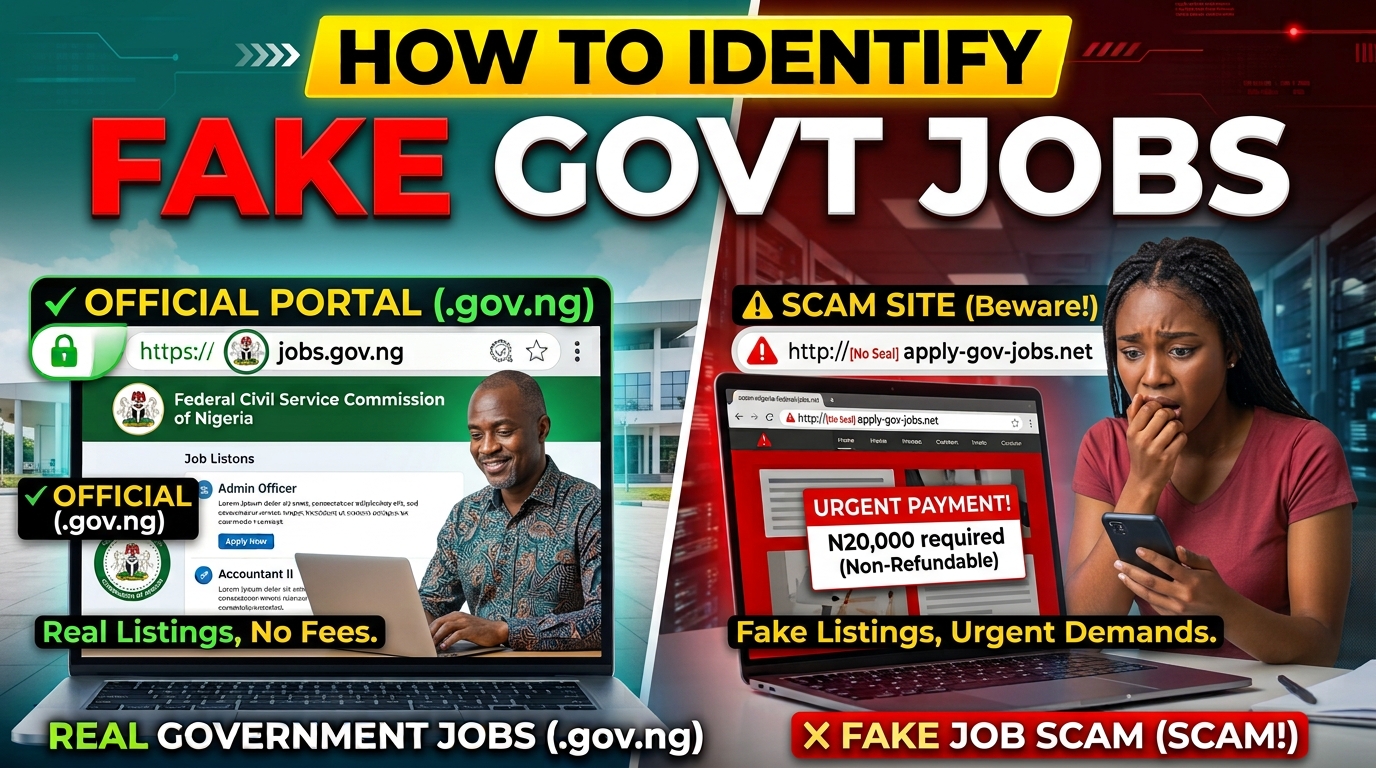
How to Identify Fake Government Recruitment Websites
Government jobs in Nigeria are highly sought after because of their relative stability, benefits, and prestige. High youth unemployment and limited formal private-sector opportunities create intense competition. Scammers systematically exploit this desperation by creating fake recruitment websites, cloned portals, social media adverts, WhatsApp and Telegram messages, and even forged appointment letters that mimic official agencies such as the Nigeria Immigration Service (NIS), Nigerian Army, Nigeria Police Force, Customs, Civil Defence, and local government bodies.
These frauds may demand “registration fees,” “processing charges,” or “facilitation payments,” steal personal and banking information, or lure victims into larger schemes. Understanding the scale of the problem, real Nigerian cases, the wider harm, practical identification methods, and the legitimate channels for applications is essential for protection.
1. Scammers Prey on People’s Desperation to Get Government Jobs
Scammers know that many Nigerians, especially young graduates and people from rural or economically strained areas, will take significant risks for the promise of a government position. They monitor official announcements, copy logos, letterheads, photographs of senior officers, and official-sounding language, then launch lookalike websites or circulate messages promising quick enlistment, replacement slots, or guaranteed appointments.
Typical methods include:
- Creating domains that resemble official ones, often ending in
.com, unofficial.ngvariants, or slight misspellings. - Posting urgent “recruitment ongoing” adverts on Facebook, WhatsApp groups, Telegram channels, and through SMS.
- Demanding payments for application forms, medical tests, uniforms, “slots,” or “facilitation.”
- Collecting bank details, National Identification Numbers, educational certificates, and other personal data under the pretext of processing applications.
- Issuing fake appointment or shortlisting letters to build credibility before demanding larger sums.
- In some cases, holding victims in locations under the guise of training or document processing for overseas or local jobs.
These operations range from individual fraudsters and small gangs to organised syndicates. Official agencies such as the NIS have repeatedly issued public disclaimers about fake websites, while the Nigerian Army and Police warn that their recruitment processes are free, transparent, and merit-based.
Desperation can sometimes override caution, with victims proceeding despite their doubts because they urgently need employment.
2. Case Studies of People Who Have Fallen Victim and Culprits Who Have Been Caught
Nigerian law enforcement and anti-corruption agencies regularly intercept recruitment scams. The following cases illustrate both the human impact and some of the interventions that have taken place.
Fake Nigeria Immigration Service Websites
Multiple cloned NIS portals have circulated over the years. One documented victim, Mercy Olayinka, a mother of one, discovered an online advert for NIS enlistment with a tight deadline. She created a profile on a fake site, uploaded documents, and was required to pay ₦1,500 to submit the application.
After entering her husband’s ATM card details, ₦4,000 was immediately withdrawn from the account. The site looked professional but lacked official social media handles or a verifiable address.
The NIS has repeatedly warned the public that recruitment is free and is announced through national dailies, radio, television, and the authentic website, immigration.gov.ng. Any other portal demanding payment should be treated with extreme caution.
Nigerian Army Recruitment Scam in Taraba
Troops of the 6 Brigade Nigerian Army in Wukari, Taraba State, arrested Felix Yadeh, 51, after a local vigilante group handed him over. Preliminary investigation showed that he collected approximately ₦3.627 million from members of the public under the pretence of securing Army recruitment slots.
He claimed that his younger brother had instructed him to collect the money. An Infinix phone and some cash were recovered.
The Army publicly reiterated that its recruitment process is free, transparent, and strictly merit-based, and urged the public to report anyone demanding money for enlistment.
Kano Government Job Scam
In September 2026, the Zone One Police Headquarters in Kano arrested Ali Mohammed, also known as Faragai, for allegedly defrauding job seekers of more than ₦40 million by promising government appointments.
More than ten victims came forward, while the suspect reportedly confessed to defrauding more than twenty people and producing fake appointment letters. Some of the forged letters were recovered as exhibits. The case remained under investigation for court charges at the time of the report.
Police Officers Accused in Niger State
Two serving officers attached to the State Criminal Investigation and Intelligence Department in Minna, Niger State, Inspector Usman Mohammed and SP Nura, were alleged to have collected more than ₦700,000 from three young men under the pretence of securing police constable recruitment slots during the 2023/2024 exercise.
The victims reportedly paid in instalments after being introduced to the officers, yet none obtained employment.
Cross River Local Government Job Scam
A state government panel found that 47 job seekers lost more than ₦51.8 million to fraudsters who sold fake Local Council positions during a cancelled 2024/2025 recruitment exercise.
Victims reportedly paid between ₦100,000 and ₦1.5 million, depending on the position. The perpetrators issued fake employment letters bearing government letterheads and forged signatures and allegedly threatened victims with blacklisting if they spoke out.
The entire exercise was cancelled and investigations into those involved began.
Other Notable Cases
- An NSCDC officer, Solomon Ogodo, was sentenced to seven years’ imprisonment for a ₦12.2 million job scam involving forged provisional appointment letters for the Nigeria Correctional Service.
- The ICPC has announced cases involving individuals accused of multi-million-naira scams promising jobs at the Central Bank of Nigeria and Federal Inland Revenue Service using forged letters.
- In Kwara, a man posing as a Customs officer was sentenced to 20 years for impersonation and job scams.
- NSCDC in Cross River rescued 42 young people, including foreigners, who were held in a Calabar facility after reportedly paying large sums for non-existent jobs in South Africa, Malaysia, and Ivory Coast. The syndicate allegedly operated under the guise of document and visa processing.
These examples show the variety of tactics used, including fake websites, forged letters, and impersonation of serving officers, as well as the response of security agencies.
3. Dangers of Fake Government Recruitment Websites and Jobs
The harm extends far beyond individual financial loss.
Direct Economic Damage
Victims can lose savings, take loans, or sell property to pay scammers. Aggregate losses from documented cases already run into tens or hundreds of millions of naira.
Erosion of Trust in Public Institutions
Repeated exposure to fraudulent government websites and letters can reduce public confidence in genuine official communications and digital government services.
Identity Theft and Secondary Crime
Personal data collected through fake recruitment portals can be used for further fraud, account takeovers, or sold through illicit channels.
National Security and Institutional Integrity Risks
When data belonging to applicants for sensitive agencies is compromised, or when serving officers participate in scams, the credibility and operational security of those institutions can be affected.
Social and Psychological Costs
Young people who invest time, money, and hope into fraudulent recruitment schemes may experience serious disappointment and financial hardship. Such experiences can also contribute to wider social tension.
Diversion of Law-Enforcement Resources
Police, Army, NIS, NSCDC, EFCC, and ICPC must devote resources to investigating scams, rescuing victims, and prosecuting suspects.
Collectively, these scams undermine the fairness of public recruitment, waste public resources, and damage public trust.
4. How to Identify Fake Government Recruitment Websites and Jobs
Apply these practical checks consistently.
Domain and Technical Indicators
- Genuine Nigerian government websites commonly use official
.gov.ngdomains. Be extremely cautious with any site ending in.com,.org,.info, or a non-standard.ngvariant that claims to handle government recruitment. - Examine the full URL for added words such as “recruitment,” “jobs,” “portal,” or “apply,” as well as hyphens and slight misspellings.
- HTTPS alone is not proof of legitimacy. Scammers can obtain security certificates too.
Content and Process Red Flags
- Any unexpected request for payment during an application, including registration fees, processing fees, medical fees, uniform fees, “slot” payments, or facilitation charges.
- Poor grammar, spelling errors, low-quality logos, or unprofessional design.
- Unrealistic promises, such as very high salaries for minimal qualifications, “no exam,” “immediate employment,” or extreme urgency.
- Contact exclusively through WhatsApp, Telegram, personal email accounts, or mobile numbers instead of official institutional channels.
- Absence of official advertisement numbers, dates, or references to published guidelines.
- Pressure to share bank details, your full NIN, passwords, or other sensitive information early in the process.
Verification Steps
- Never click recruitment links received through social media, WhatsApp, SMS, or email without independent verification. Type the official agency address yourself or navigate from a known government portal.
- Cross-check any vacancy announcement on the agency’s authentic website and through its verified social media channels.
- Confirm that recruitment is actually open by checking recent official press releases or the Civil Defence, Correctional, Fire and Immigration Services Board (CDCFIB) portal where applicable.
- Search the site name or advert text together with terms such as “scam” or “fake” and review recent official disclaimers.
- Contact the agency only through telephone numbers or email addresses published on its genuine website.
- Report suspicious websites or individuals to the nearest police station, the agency’s public relations office, or appropriate Nigerian cybercrime reporting channels.
If anything feels wrong, stop the process and verify independently.
5. Original Websites That Host Government Jobs and the Application Process
Restrict applications to official channels only. Legitimate Nigerian government recruitment is announced through national newspapers, radio, television, and the authentic websites of the recruiting agencies. Applicants should not rely on private agents or unofficial “facilitators.”
Key Official Nigerian Portals and Sources
Nigeria Immigration Service: Recruitment involving the NIS is coordinated by the Civil Defence, Correctional, Fire and Immigration Services Board (CDCFIB). Use the official CDCFIB recruitment portal when recruitment is active.
Nigerian Army: Official announcements appear on the Army’s verified website and social media channels. Recruitment is free and merit-based.
Nigeria Police Force: Official recruitment notices are published through the Force’s authentic channels. Do not trust circulating “training orders” or unofficial portals.
Federal Civil Service Commission and individual ministries/agencies: Check the specific ministry or agency’s official .gov.ng website for career or vacancy sections.
Other paramilitary and security agencies: Follow announcements from the Ministry of Interior and the CDCFIB.
State and local government jobs: Verify opportunities exclusively through the official state government website or the relevant local government service commission portal.
General Application Process
- Create a profile or submit documents only on the official recruitment portal.
- Prepare the required documents in the exact format requested.
- Observe published deadlines and examination or screening dates.
- Track your application status solely through the official system.
- Treat communications from unofficial numbers, personal accounts, or unverified agents with caution.
For broader reference, other countries maintain central government job portals, such as USAJOBS.gov in the United States and Civil Service Jobs in the United Kingdom. Nigerian applicants, however, should prioritise the official Nigerian sources relevant to the opportunity.
Knowing how to identify fake government recruitment websites can help job seekers avoid losing money, exposing sensitive information, or becoming victims of recruitment fraud. When in doubt, pause and verify through the recruiting agency’s official channels before taking the next step.