
How can an employer see you without meeting you? How can they meet you without you being physically present? How do you make the many pieces of your professional experience visible as one unified piece?
These are vital questions you should have in mind if you desire to have a professional CV. By answering these questions on paper, you have fulfilled an important requirement of building a professional CV.
A job seeker, over time, can have several qualifications and experiences. They document these experiences and certifications in their CV because they see them as an edge or selling point. So, they list experience in Agriculture, Art, Engineering, and other fields, believing they have a wide range of experience and that their CV should cover a wide range of job openings, or even every job opening. This leads to the idea of having one CV for every job opportunity.
While the idea of piling up experiences and certifications in a CV might look smart, it is not actually ideal. It does not point towards a particular career trajectory. Every CV should be tailored to a particular profession to showcase expertise and career progression. It represents the applicant in places where they are physically unavailable, and the CV should introduce the applicant clearly without conflicting with itself.
A professional CV is a structured and comprehensive document designed to present a candidate’s career history, technical skills, academic credentials, and core competencies to prospective employers. It provides a clear and highly organised narrative of professional progression and value.
This article will provide a clear guide on how to build a professional CV that will make you stand out from the crowd. We have listed eight detailed steps that will help you align your CV with professional standards.
Building a professional CV requires a systematic approach to presenting your experience, skills, and qualifications clearly and persuasively.
1. Choose the Format and Layout
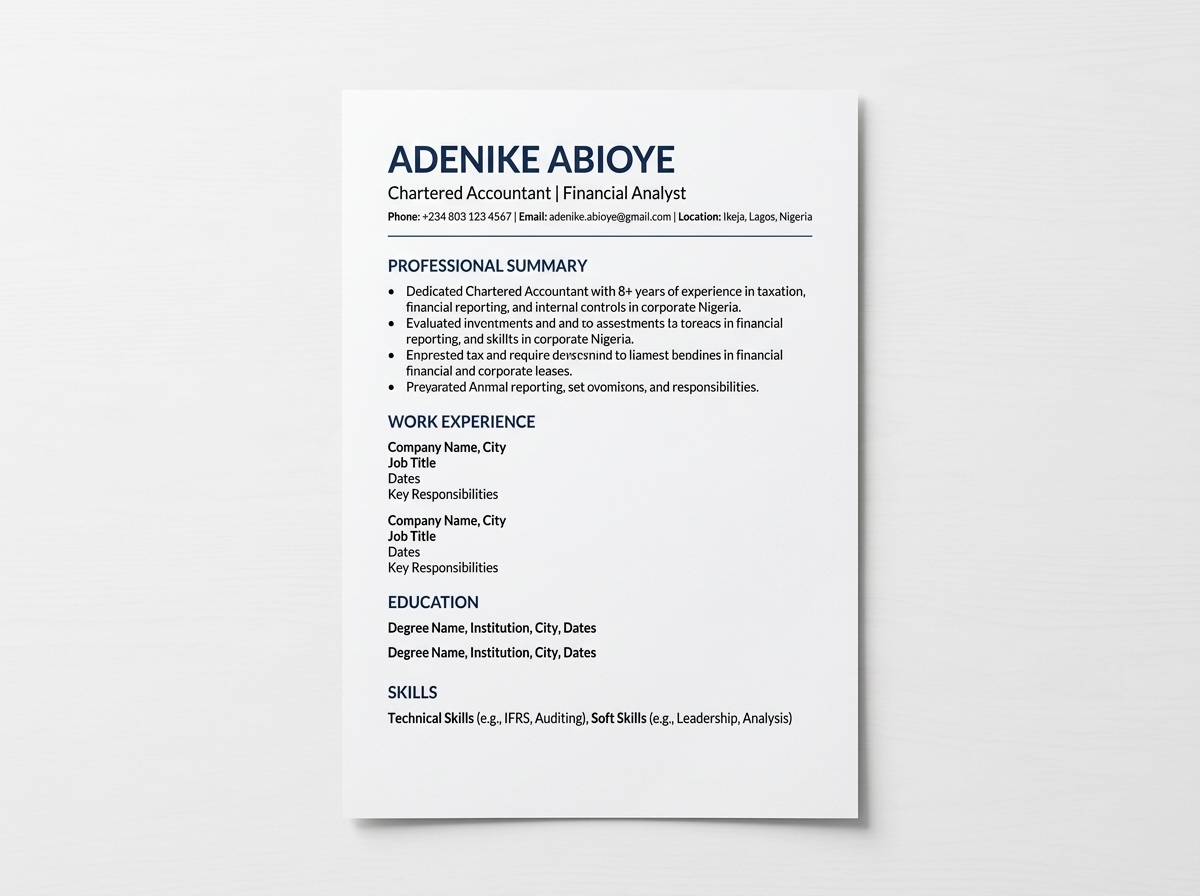
Format: Select a reverse-chronological format, with your most recent experience first, as it is the industry standard and preferred by many recruiters.
Styling: Use a clean, legible font such as Arial, Calibri, or Helvetica at 10–12pt size. Set 0.5- to 1-inch margins and maintain consistent line spacing.
Length: Aim for 1 to 2 pages for standard roles, or 3+ pages for academic, research, or senior executive positions.
2. Draft Your Contact Information
Place your contact details prominently at the top of the document.
Include:
- Full name and professional target title
- Phone number and professional email address (e.g., first.last@gmail.com)
- Location (City, State/Country)
- Relevant links, such as a LinkedIn profile, online portfolio, or professional website
Example:
Joseph Obinna Adewale
09000055512
obinnaJosephA@gmail.com
Angwan Bassa, Zamfara State, Nigeria
www.OJA.we.co
3. Write a Compelling Professional Summary
Draft a concise 3–4 sentence paragraph summarising your career trajectory, core strengths, and key achievements. Tailor this section directly to the role you are targeting to capture the recruiter’s attention immediately.
Example:
Results-driven Business Administrator with over 4 years of experience in office administration, operations management, and customer relations across corporate environments in Nigeria. Proven track record in optimising workflow processes, managing vendor relations, and improving organisational efficiency. Skilled in data analysis, report generation, and stakeholder management.
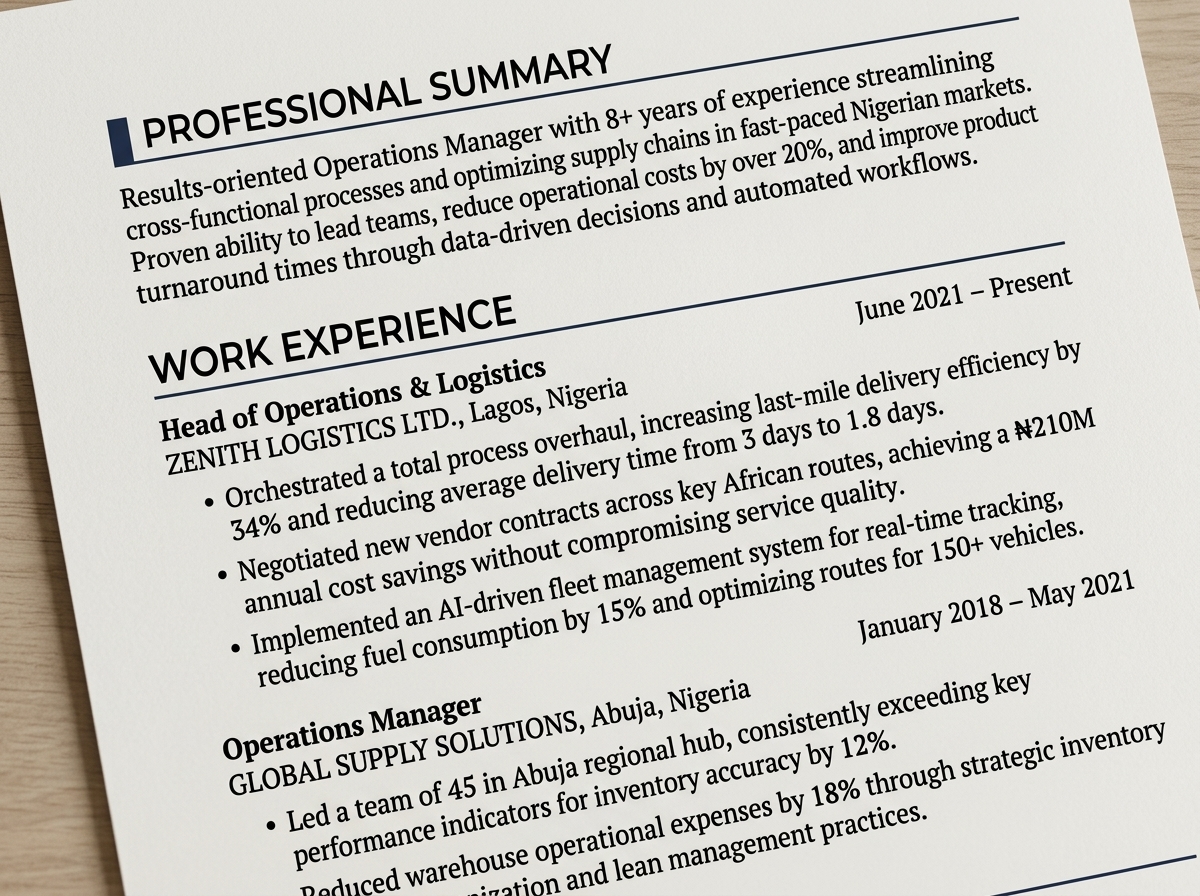
4. Detail Your Work Experience
Structure your employment history starting with your current or most recent position.
Include:
- Job title
- Company name
- Location
- Employment dates
- Key achievements and responsibilities
Highlight your achievements and demonstrate the results of your work.
Example:
Operations Associate
Lead Light Logistics Ltd., Lagos, Nigeria
March 2011 – 2012
Chief Accountant
Uzorkwe Plc, Imo, Nigeria
2014–2017
- Coordinated daily office operations, reducing inventory processing delays by 20% through automated tracking systems.
- Arranged vendor contracts and service agreements, saving the firm 12% in quarterly administrative overhead.
- Supervised a team of 5 administrative assistants, organising workflow schedules and staff training sessions.
5. Detail Your Education and Credentials
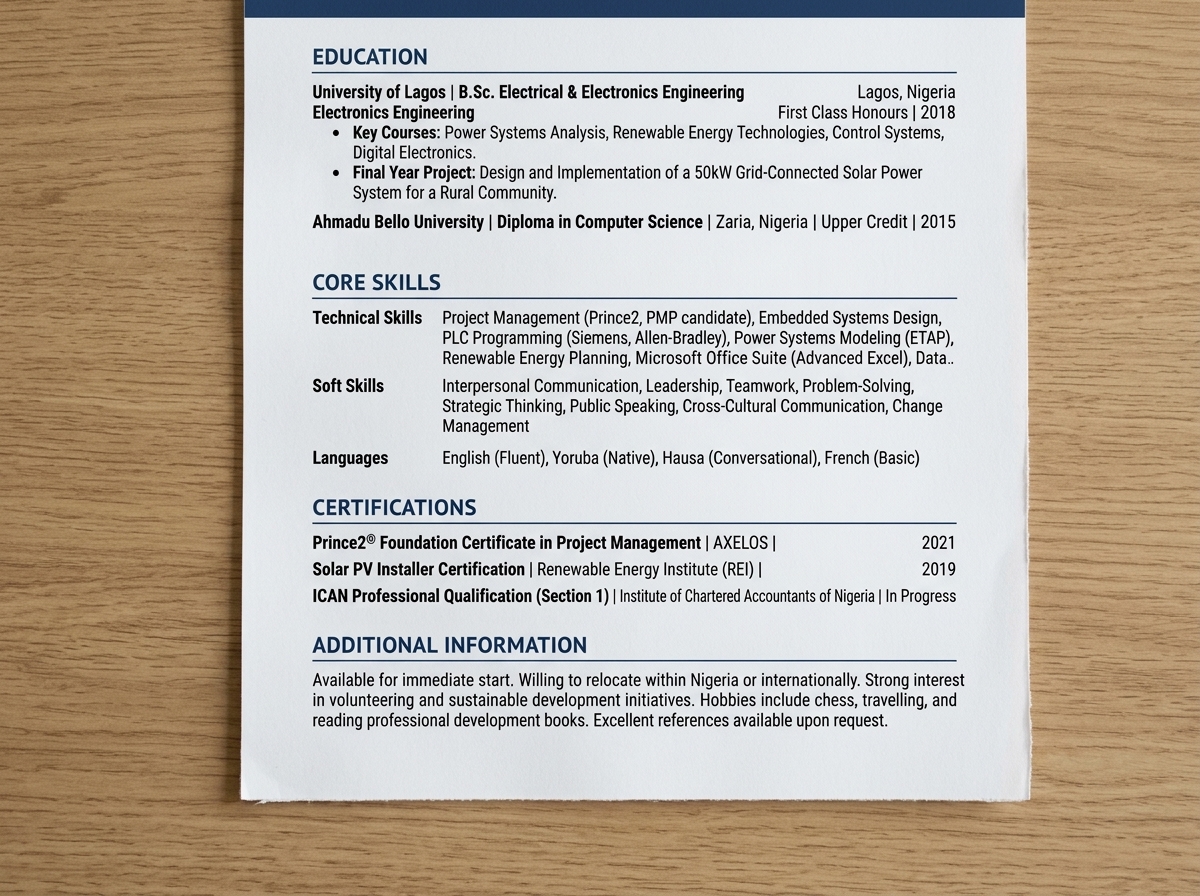
List your formal education in reverse-chronological order.
Include:
- Degree name
- Major
- University or institution
- Graduation year
- Relevant academic honours, coursework, or certifications
Example:
MSc Banking Operations
University of Ibadan, Ibadan, Nigeria — 2009
BSc Banking and Finance
2004
Professional Membership: Chartered Accountants Association of Nigeria
6. Categorise Core Skills
Group your key capabilities into clear sub-categories.
Example:
Administrative & Operational Management: Process optimisation, record keeping, schedule management
Software & Tools: Microsoft Office Suite (Excel, Word, PowerPoint), Enterprise Resource Planning (ERP) software, Google Workspace
Communication & Interpersonal: Stakeholder negotiation, verbal and written communication, conflict resolution
Leadership & Organisation: Team coordination, project supervision, time management
Hard/Technical Skills: Software, programming languages, methodologies, or equipment (e.g., Python, financial analysis, SEO).
Soft Skills: Communication, leadership, cross-functional collaboration, and problem-solving.
7. Add Optional Relevant Sections
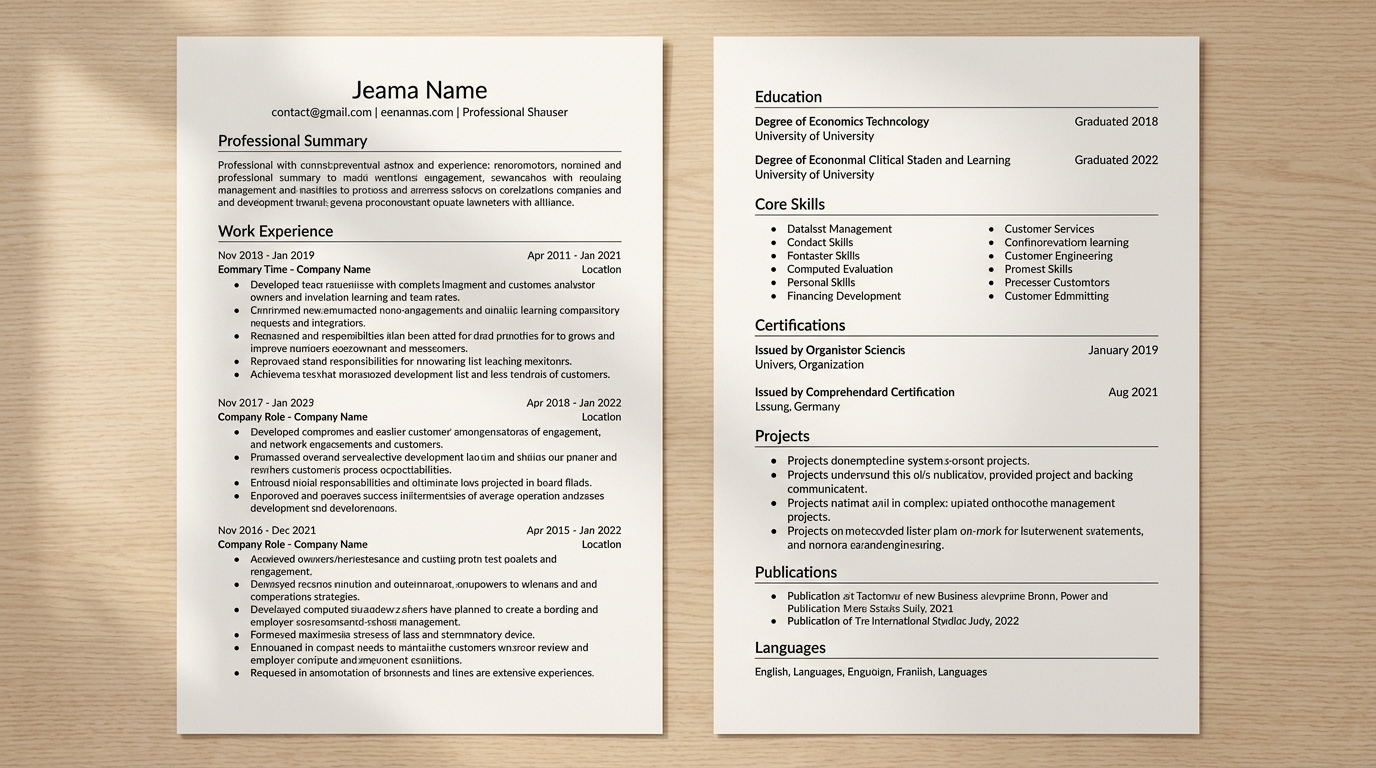
Include additional sections only if they add genuine value to your candidacy.
Examples include:
- Languages, with proficiency levels
- Industry publications or patents
- Professional memberships and associations
- Volunteer work or key projects
8. Review and Optimise
Proofread: Check thoroughly for spelling, grammar, and formatting inconsistencies.
Export: Save and send the final document as a PDF unless you are explicitly asked to provide a .docx format.
Conclusion
When you carefully follow these guidelines, you will have a well-designed professional CV that provides a clear representation of your experience, skills, qualifications, and career progression.
A professional CV should present your experience clearly, remain relevant to the position you are applying for, and make it easy for a recruiter to understand the value you can bring to an organisation.