
How to Write an Ideal CV: A Complete Guide to Creating a Job-Winning CV
Why do qualified applicants keep getting rejected for jobs?
Many job seekers apply repeatedly for positions they are qualified for, yet continue to face rejection. Some blame circumstances beyond their control, while others eventually give up on their dream jobs without identifying the real problem.
In many cases, the problem may be how the applicant presents their qualifications and experience on their CV.
Every job advertisement has an important section called Requirements. This section explains what the employer expects from applicants and often provides the criteria used to identify suitable candidates.
Your Curriculum Vitae (CV) is one of the most important documents in a job application. It presents your professional background, skills, qualifications, experience and achievements to a potential employer. A well-written CV can help you stand out from other applicants, while a poorly structured or irrelevant CV can make it difficult for an employer to see your value.
So, what makes an ideal CV?

What Should a Good CV Do?
When writing a CV, the first question you should ask is:
What does the employer need?
Study the job description carefully. Identify the responsibilities, skills, qualifications and experience the employer is looking for. Then, demonstrate how your own experience and abilities can meet those needs.
A strong CV is not simply a record of everything you have ever done. It is a targeted document that shows an employer why you are suitable for a particular role.
Think of it this way: an employer has a problem that needs to be solved and is looking for someone with the right ability to solve it. Your CV should make it easy for the employer to see that you have the relevant skills, experience and track record.
For example, if an organisation is looking for a data analyst, simply writing “Data Analyst” on your CV is not enough. You should demonstrate what you have actually done with your analytical skills and the results you achieved.
This is one of the most important principles of effective CV writing:
Don’t just tell employers what you can do. Show them what you have achieved.

Leonardo da Vinci and the First Professional CV
According to an article published by the University of Leicester, Leonardo da Vinci is widely credited with creating one of the earliest professional CVs around 1482.
While looking for work in Milan, Da Vinci wrote a letter to Ludovico Sforza. The letter provides an interesting example of how job seekers can present their abilities to a potential employer.
Da Vinci first demonstrated his understanding of his potential employer’s needs. He identified weaknesses in Sforza’s military capabilities and then explained how his own expertise could provide solutions.
He highlighted his abilities in areas including engineering, military technology, bridges, canals, fortifications and machines. He presented himself as someone who could solve specific problems.
He also mentioned his abilities as a painter and sculptor.
The lesson is clear: identify what the employer needs and demonstrate how your abilities can provide value.
Your strongest qualifications should be presented in a way that connects directly to the job you want.
Your additional skills can then strengthen your overall profile.

Common CV Mistakes Job Seekers Should Avoid
A good CV can improve your chances of getting noticed, but several common mistakes can weaken an otherwise strong application.
1. Listing Responsibilities Instead of Achievements
One of the most common CV mistakes is simply listing responsibilities.
For example:
- Content creation
- Graphic design
- Data analysis
- Social media management
These statements tell an employer what you were responsible for, but they do not necessarily demonstrate the value you created.
Instead, focus on achievements and results.
For example:
Analysed complex business data to identify trends and provide insights that supported problem-solving and decision-making.
Or:
Created social media content that increased audience engagement and contributed to additional sales opportunities.
Whenever possible, include measurable results such as percentages, revenue, audience growth, cost savings, efficiency improvements or the number of people you managed.
Responsibilities describe your duties. Achievements demonstrate your value.
2. Using the Same CV for Every Job
Another common mistake is sending the same CV to every employer.
A CV should be tailored to the specific job you are applying for.
For example, if you are applying for a medical position but your CV is primarily designed around academic work, you may fail to highlight the experience and skills the employer actually needs.
This does not necessarily mean you are unqualified. It may simply mean that your CV is not presenting your qualifications in the most relevant way.
Before applying, carefully read the job description and identify:
- Required qualifications
- Technical skills
- Professional experience
- Industry-specific terminology
- Key responsibilities
- Preferred competencies
Then make sure your CV clearly reflects the requirements you genuinely meet.
3. Including Too Much Irrelevant Personal Information
Another common problem is including personal information that has little or no relevance to the position.
The employer’s primary concern is whether you have the qualifications, skills and experience required for the role.
Unless specifically requested or relevant to the position, consider leaving out information such as:
Marital or Family Status
Whether you are single, married or have children generally has no bearing on your professional ability.
Age or Date of Birth
Including your age or date of birth may create unnecessary opportunities for age-related bias.
Full Physical Address
A complete street address, house number or postal code is usually unnecessary at the initial application stage. Your city and state/country are generally sufficient.
Identification Numbers
Do not include sensitive identification numbers such as national ID or passport numbers on a CV unless an employer specifically and legitimately requires them through an appropriate process.
Personal Beliefs
Religion, political affiliations and other personal beliefs generally do not belong on a professional CV unless they are directly relevant to the organisation or position.
The general rule is simple:
If information is not relevant to the job and has not been requested, consider leaving it out.
A CV should be concise, relevant and easy to read.
What Is the Ideal CV Format?
There is no single CV format that works perfectly for everyone.
The best CV structure depends on your career stage, industry, experience and the specific position you are applying for.
However, there are four important areas to consider when creating an effective CV.
1. Identify Your Industry
First, understand the expectations of your industry and the type of organisation you are applying to.
Corporate and Traditional Careers
Fields such as law, finance and business generally benefit from a clean and professional layout with traditional headings and straightforward formatting.
Creative Careers
Fields such as graphic design, marketing and media allow for some creative styling. However, creativity should never come at the expense of clarity and readability.
Technical and Academic Careers
Fields such as IT, science and education often require greater emphasis on technical skills, certifications, qualifications, research, degrees and specialised tools.
Your CV should reflect the expectations of your industry while remaining easy for employers and recruitment systems to read.
2. Analyse the Job Description and Match Relevant Keywords
One of the most important CV writing tips is to read the job description carefully before submitting your application.
Identify the exact skills, qualifications, tools and responsibilities mentioned by the employer.
Where they genuinely apply to your experience, use relevant terminology from the job description in your CV.
This is particularly important because many organisations use Applicant Tracking Systems (ATS) to screen applications before they reach a recruiter.
An ATS-friendly CV should have:
- Clear section headings
- Relevant keywords
- Simple formatting
- Easy-to-read text
- Clearly defined skills and experience
- No unnecessary design elements that interfere with text extraction
Never add keywords that do not accurately describe your experience. The goal is to make your genuine qualifications easier to identify, not to manipulate the recruitment process.
3. Include Only Essential Information
A strong CV should provide the information an employer needs to evaluate your suitability for the position.
Contact Information
Include:
- Full name
- Phone number
- Professional email address
- City and state/country
- LinkedIn profile
- Portfolio or professional website, where relevant
Use a professional email address rather than an email that could appear unsuitable for a job application.
Professional Summary
Your professional summary should be a short introduction of about 2–4 sentences.
It should communicate:
- Your professional identity
- Your key skills
- Your relevant experience
- Your strongest achievements
- The value you can bring to the position
Avoid vague statements that could apply to almost anyone.
Work Experience
For each relevant position, include:
- Job title
- Company or organisation
- Location
- Employment dates
- Key achievements and responsibilities
Focus particularly on results.
Instead of:
Responsible for managing social media.
Consider:
Managed social media content and campaigns, improving audience engagement and supporting the organisation’s digital marketing goals.
Skills and Tools
List technical skills, software, tools and professional competencies that are relevant to the position.
Examples include:
- Project Coordination
- Financial Analysis
- Data Analysis
- Adobe Photoshop
- Microsoft Excel
- Digital Marketing
- Project Management
- Programming Languages
Prioritise skills that are relevant to the job rather than creating an unnecessarily long list.
Education and Credentials
Include:
- Degree or diploma
- Institution
- Graduation year
- Relevant certifications
- Professional licences
- Relevant specialised training
Prioritise qualifications that strengthen your suitability for the position.
4. Keep Your CV at the Right Length
A CV should contain enough information to demonstrate your qualifications without becoming unnecessarily long.
Recruiters may have to review a large number of applications, so a concise and well-organised CV can make it easier for them to identify your strongest qualifications.
One Page
A one-page CV is often suitable for:
- Entry-level applicants
- Fresh graduates
- Applicants with limited professional experience
Two Pages
Two pages can be appropriate for mid-level and senior professionals who have substantial relevant experience.
Avoid Unnecessary Extra Pages
Unless you are preparing an academic CV or have extensive experience that genuinely requires additional space, avoid adding pages simply to make your CV look more impressive.
Remove outdated, repetitive and irrelevant information.

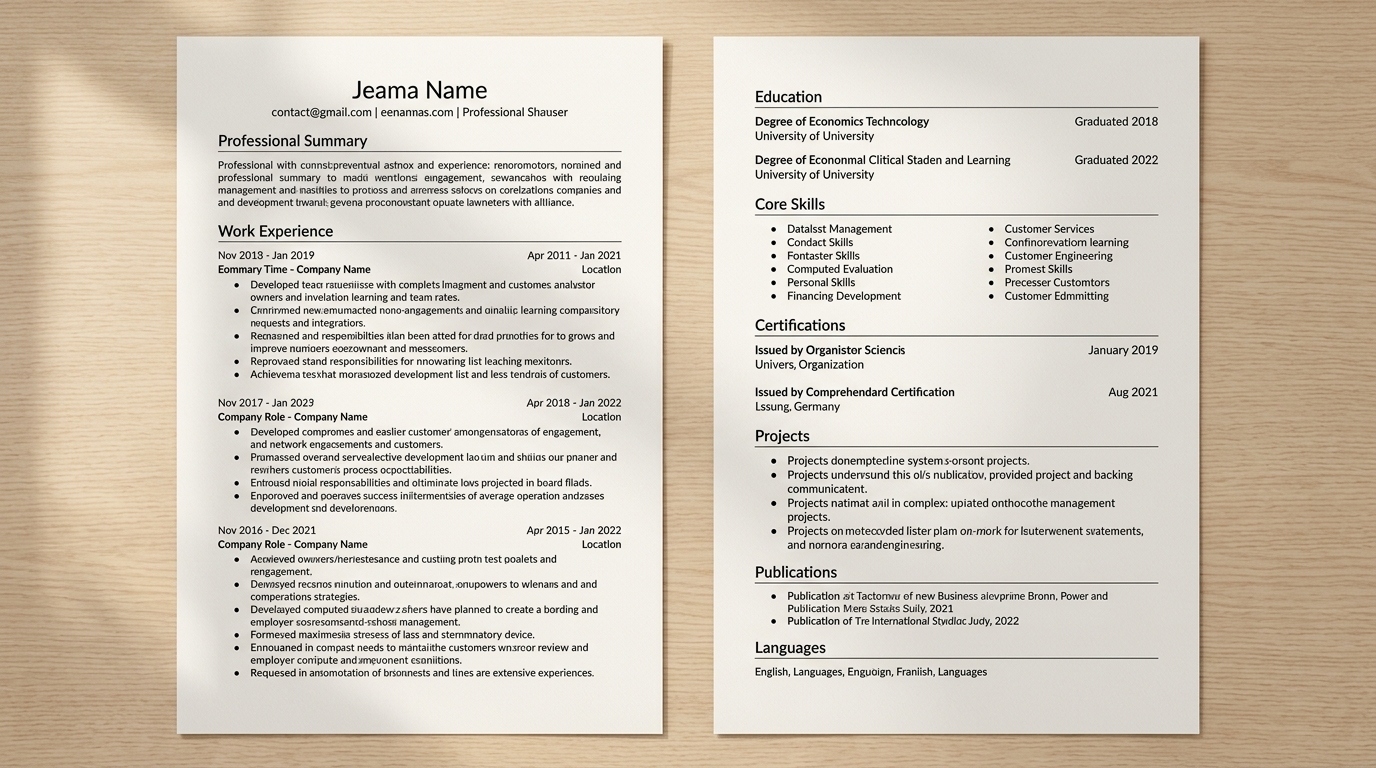
Essential CV Sections
Every standard professional CV should contain clearly organised sections that allow both recruiters and applicant tracking systems to quickly identify important information.
1. Contact Details
Place your name prominently at the top.
Include:
- Full name
- Phone number
- Professional email
- Location
- LinkedIn profile
- Portfolio, where relevant
2. Professional Summary or Profile
Write a concise professional summary that introduces your experience, key strengths and the value you can bring to the role.
3. Work Experience
List relevant positions in reverse chronological order, starting with your most recent role.
Use strong action verbs and focus on measurable achievements.
For example:
Improved audience engagement by 15%.
is stronger than:
Responsible for social media engagement.
4. Skills and Tools
Highlight technical skills, professional competencies and tools that are relevant to the position.
5. Education and Credentials
List your relevant degrees, diplomas, certifications, licences and professional training.
Conclusion: Your CV Is Your Professional Marketing Tool
An ideal CV is more than a list of previous jobs and responsibilities. It is a strategic professional marketing document that communicates your value to a potential employer.
In a competitive job market, employers may receive dozens or even hundreds of applications for a single position. A well-structured and targeted CV helps your most relevant qualifications, technical abilities and achievements stand out.
To create a stronger CV:
- Understand the job you are applying for.
- Study the employer’s requirements carefully.
- Tailor your CV to the specific position.
- Use relevant keywords naturally.
- Focus on achievements rather than responsibilities.
- Remove unnecessary personal information.
- Keep your CV concise and easy to read.
- Use a professional structure appropriate for your industry.
Taking the time to match your CV to the specific job and clearly communicate your professional value can significantly improve the quality of your applications and your chances of progressing to the interview stage.
Your CV should not simply tell an employer where you have been. It should show them why you are the right person for where they are going.